
Understanding itel batteries
Choose the voltage, power and backup time you need.
Compare itel battery capacities, understand 12V, 24V and 48V pairings, and estimate backup time before choosing an inverter and solar panels.
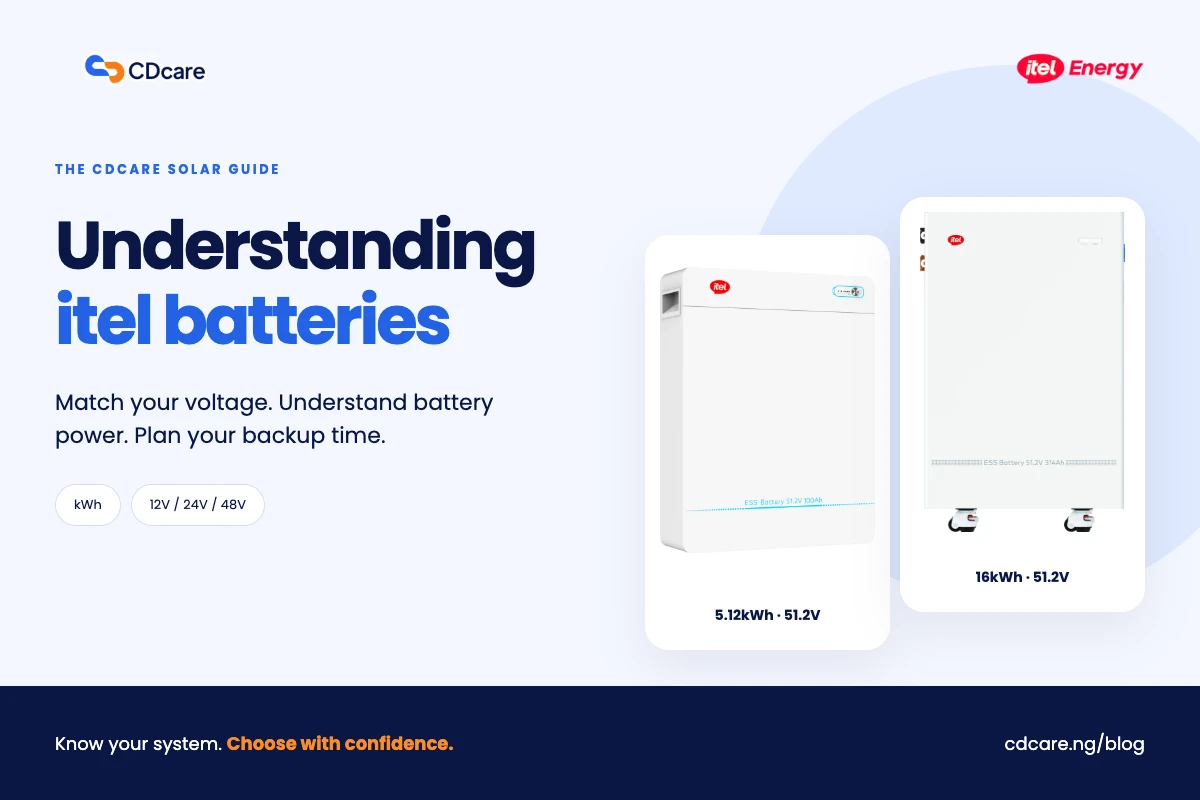
Loading the interactive system planner…
A system that fits together.
Choose an inverter. We’ll suggest a battery combination and one solar-panel option, with a reason for each. Change the battery quantity to explore longer backup, or open the alternatives to compare.
Recommendations are planning starting points. Your actual loads, exact equipment labels and installation determine the final system.
Choose your inverter
Match your battery
Approved parallel connection keeps the voltage the same and adds storage. Two batteries do not double the inverter’s power.
Compare battery options
Batteries are arranged from smallest to largest by storage per unit. Tap a row to choose. Recommended combinations include a suggested quantity, which you can change above. kWh measures stored energy; amps describe continuous output.
The 32kWh option includes published current and parallel ratings. Match the installed BMS protocol and charging settings to the supplied inverter and battery.
Understand the backup-time calculation
Battery-only runtime = nominal storage × 80% usable energy × 90% conversion efficiency ÷ AC load. No solar or mains contribution is assumed. The current check compares required DC current at nominal voltage and at the published minimum battery voltage with both the combined battery rating and the inverter’s maximum discharge current. If only the nominal check passes, the displayed time is labelled an energy estimate; the load can stop earlier as voltage falls.
Battery voltage falls during use. Starting surges, inverter idle use, ageing, temperature and unequal current sharing can shorten runtime. Even when the low-voltage check passes, BMS derating, the configured reserve and installation conditions can reduce usable output. A larger bank cannot override an inverter’s own current limit.
Add your solar panels
Compare other solar panels
These are catalogue alternatives. A higher wattage panel is not automatically a better electrical match.
Why this panel quantity?
This starting estimate takes the larger of two targets: an array nameplate rating equal to 50% of the inverter’s kW rating, or enough panel capacity to replace 80% of the selected battery bank’s nominal energy over 4 equivalent peak-sun-hours with 75% DC solar availability and 95% battery charging efficiency. It rounds up to whole panels, then chooses a quantity within the PV wattage ceiling and the available nominal voltage/current screen. If those limits prevent the target, it shows a smaller array and explains the shortfall. For the documented Jinko 625W panel, the screen also checks Voc at a reference cell temperature of 10°C. This is not a site temperature assumption; an installer must replace it with the design minimum and apply voltage tolerances. Unknown panel suffixes remain energy illustrations.
The 50% target is an editorial starting point for comparing systems, not a manufacturer rule. Four peak-sun-hours is a scenario, not four clock hours or a forecast for your roof. Weather, shade, orientation and daytime loads change the required array. This estimate excludes energy consumed while charging and does not approve a string layout.
Final panel count and string layout must meet MPPT start-up and operating voltage, cold Voc, operating and short-circuit current limits, bifacial conditions and charging limits. The installer may need to change this starting quantity.
Where does each cable go?
Follow the arrows, then tap a part to understand it. Panels go to PV, batteries go to BAT, and appliances go to the protected AC output.
This is a map of what connects to what, with a teaching example where panel data is available. It is not a terminal drawing or an installation sequence. The installer must specify cable sizes, fuse/breaker ratings, polarity, string layout and earthing for the exact equipment and site.
Which “cutout”, breaker and protection does this system need?
| Part | Plain meaning | What the installer must select |
|---|---|---|
| PV DC isolator | Disconnects the solar input for the required work. It is not automatically a fuse. | PV-rated DC voltage, current, poles and switching duty for the final strings. Panels and upstream cables remain live in sunlight. |
| PV string fuses / DC breakers, where required | Protect against excessive current or backfeed into a string. | Need and rating depend on parallel strings, module maximum series-fuse rating, corrected current and cable capacity. |
| Battery fuse / suitable DC breaker and isolator | Protects the battery cable and permits isolation. Each parallel branch needs the protection specified by the design. | DC voltage, continuous current, surge coordination, cable capacity and enough fault-interruption capacity for the battery bank. Follow the battery manual for placement and polarity. |
| AC breaker and RCD/RCBO | The breaker addresses overcurrent. An RCD detects leakage; an RCBO combines both functions. | Input and output circuit ratings, fault protection, the required RCD type and the correct neutral/earth arrangement for this inverter. |
| PV DC and AC surge protection (SPDs) | Limits short voltage surges on the relevant circuits. It does not replace a breaker or an external lightning system. | Correct DC/AC device, voltage rating, Type 1/2 requirements, backup protection, placement and short bonding paths, coordinated with the building’s lightning design. |
An AC-only breaker is not a battery or PV cutout. The inverter’s kW rating alone cannot determine a safe fuse or cable size.
Try series and parallel: same four panels, different voltage and current
Same four panels. Different electrical result.
Four Jinko 625W panels, using the JKM625N-66HL4M-BDV datasheet at standard test conditions. This teaching example is separate from the combination selected above.
Educational circuit only: fuses, isolators, earthing, surge protection and actual connector routing are omitted. This is not an approved layout for your selected inverter.
Design references: IEC PV-array design scope · DC wiring and fault protection · DEHN: rooftop PV lightning and surge protection. These support the principles; itel manuals govern the exact equipment.
Run appliances. Refill the battery.
Panels can power appliances through the inverter and use the remaining energy to charge the battery. See how a daytime load changes the time needed to recharge from 20% to 100%.
Use measured average watts, allowing for appliances that cycle on and off. Four peak-sun-hours is a comparison scenario, not a local sunshine forecast.
How the charging estimate works
Your inverter determines how much AC power the system can supply. Your battery determines how much energy you have stored and how quickly that energy can be delivered. A good pairing needs both. This guide covers seven standalone itel battery options on CDcare, including the confirmed IPL-51200H 10.24kWh model.
Start with voltage, then look at kWh
For the itel models in our inverter guide, the 1.5kW inverter uses a 12V battery family, the 4kW Pro uses 24V, and the 6kW Pro, 6.6kW, single-phase 8/11/12kW and three-phase 8/12kW models use 48V. Their corresponding lithium nominal voltages are typically 12.8V, 25.6V and 51.2V.
Energy is approximately volts × amp-hours ÷ 1,000. Thus 25.6V × 200Ah and 51.2V × 100Ah both equal 5.12kWh. They hold the same nominal amount of energy, but they belong to different system-voltage families. Never choose between them on “5kWh” alone.
Compare the itel battery listings
| Battery on CDcare | Nominal storage / voltage | Continuous discharge | Inverter pairing note |
|---|---|---|---|
| IPB-121001.28kWh | 12.8V / 100Ah12V system | 50A standard† | 1.5kW: voltage-family candidate; one unit is not a promise of 1.5kW battery-only output. |
| IPW-251002.56kWh | 25.6V / 100Ah24V system | 100A | 4kW Pro: suitable voltage family, but one battery cannot sustain the inverter’s full 4kW from stored energy. |
| IPL-25200X5.12kWh | 25.6V / 200Ah24V system | 200A | 4kW Pro: the larger 24V option. Confirm inverter communication and the load at low battery voltage. |
| IPW-511005.12kWh | 51.2V / 100Ah48V system | 100A | 48V inverters: match battery quantity to demand; one unit does not provide 6–12kW battery-only output. |
| IPL-51200H10.24kWh | 51.2V / 200Ah48V system | 200A | Confirmed H model in the CDcare range. Match the 48V inverter, required current and approved communication settings. |
| IPL-51314H16kWh | 51.2V / 314Ah48V system | 157A‡ | 48V family. Useful storage capacity, but one unit is not a confirmed full-power match for an 11kW or 12kW load. |
| IPL-51628H32kWh | 51.2V / 628Ah48V system | 300A | itel Solar’s published table gives 300A continuous discharge, 250A maximum continuous charge and 32 parallel units. The calculator also applies the inverter’s own current ceiling. |
Specifications are reconciled with manufacturer documents and the supplied itel Nigeria product list. That list confirms IPL-51200H and IPL-51628 at 51.2V/628Ah. The latter is listed on CDcare as IPL-51628H; 51.2 × 628 gives about 32.15kWh, marketed as 32kWh. The 32kWh model now has runtime, charging and 1–4-unit comparisons using the itel Solar technical table.
†The February 2026 IPB-12100 manual specifies 50A standard current, 90A for 3 seconds and four parallel units. A conflicting global sheet lists 90A continuous and 16 parallel. The calculator uses the lower manual figures; confirm the supplied revision. ‡The IPL-51314H sheet lists 157A continuous discharge even though its marketing panel contains higher power language. This guide uses the electrical-table limit conservatively and does not promise full 11–12kW output from one unit.
Technical references: itel IPB-12100 manual, February 2026 · itel IPW-25100 manual · itel IPL-25200X manufacturer sheet (Solar Guide mirror) · itel IPW-51100 manual, June 2025 revision · itel IPL-51200H manufacturer datasheet · itel IPL-51314H manufacturer datasheet · itel Solar distributor: IPL-51628H technical specifications
Battery capacity and battery power are different
A 100A battery at 51.2V corresponds to about 5.12kW of DC power at that nominal voltage, before inverter losses. At a lower battery voltage, the same current represents less power. That is why one 5.12kWh, 100A battery must not be advertised as automatically powering a 6kW, 8kW or 12kW inverter at full load.
For a worked example, a 5kW AC load at an assumed 90% conversion efficiency and 48V battery voltage needs about 5,000 ÷ (0.90 × 48) = 116A. A battery limited to 100A cannot meet that continuous demand alone. The inverter’s own battery-current ceiling, cable limits and start-up demand must also be checked.
The 16kWh IPL-51314H illustrates another distinction: it stores more energy than the 10.24kWh IPL-51200H, but the reviewed tables give 157A and 200A continuous discharge respectively. More kWh does not necessarily mean a higher continuous current. For full inverter output, size a manufacturer-approved battery bank using the actual operating-voltage range.
Technical references: itel IPW-51100 manual, June 2025 revision · itel IPL-51200H manufacturer datasheet · itel IPL-51314H manufacturer datasheet
How long can an itel battery last?
A useful planning estimate is runtime ≈ nominal kWh × usable fraction × conversion efficiency ÷ average load in kW. The table below assumes 80% of nominal storage is used and 90% conversion efficiency. These are illustration assumptions, not measured performance or the mandatory settings for every model.
| Nominal battery storage | At 500W average load | At 1,000W average load |
|---|---|---|
| 1.28kWh · one IPB-12100 | 1.8 hours | Exceeds the 50A sustained-current allowance |
| 2.56kWh | 3.7 hours | 1.8 hours |
| 5.12kWh | 7.4 hours | 3.7 hours |
| 10.24kWh | 14.7 hours | 7.4 hours |
| 16kWh | 23.0 hours | 11.5 hours |
| 32kWh | 46.1 hours | 23.0 hours |
These are energy estimates only. Each load must separately pass the battery and inverter’s continuous-power checks. Real runtime changes with reserve settings, battery age, temperature, inverter idle consumption, cable losses and how the appliances cycle. A fridge’s nameplate wattage is not necessarily its average consumption, and an air conditioner’s demand can vary widely.
To estimate your requirement, first find average consumption. A 500W average essential load for six hours needs 3kWh delivered to the appliances. Under the same 80% and 90% assumptions, nominal storage would need to be about 3 ÷ 0.72 = 4.17kWh, before any additional design margin. A 5.12kWh option is therefore worth assessing for energy; voltage and power capability still decide the pairing.
Battery and inverter combinations to assess
| Inverter family | Battery listings to assess | Pairing condition |
|---|---|---|
| 12V: 1.5kW | IPB-12100 · 1.28kWh | Match charge settings and continuous current. Do not promise full 1.5kW from one small battery. |
| 24V: 4kW Pro | IPW-25100 · 2.56kWh IPL-25200X · 5.12kWh | One IPW-25100 is limited by 100A discharge. Size the bank for both running load and start-up surges. |
| 48V: 6kW Pro, 6.6kW, single-phase 8/11/12kW and three-phase 8/12kW | IPW-51100 · 5.12kWh IPL-51200H · 10.24kWh IPL-51314H · 16kWh | 51.2V lithium is the relevant nominal family. Verify current, protocol, cable pinout and approved battery quantity. |
| 32kWh listing | View the listed 32kWh battery | 51.2V / 628Ah, 300A continuous discharge and up to 32 parallel units in the itel Solar technical table. Explore 1–4 units; inverter current limits and commissioning settings still apply. |
For the 11kW IPV-11K48T, our starting recommendation is one 32kWh IPL-51628H. A recommended alternative is two 16kWh IPL-51314H batteries, giving 32kWh total and more current capability than a single 16kWh unit. The inverter’s own current ceiling still applies; compare the load estimates and increase storage if you need longer backup.
The 24V IPL-25200X is the relevant 5.12kWh option for the 4kW Pro. The 51.2V IPW-51100 and suitably verified 48V variants belong with the 48V inverters. The 32kWh IPL-51628H is a 51.2V, 628Ah option with a published 300A continuous-discharge rating. Its 250A maximum charging allowance is capped by the inverter’s charging limit in this guide.
For quick comparison, open the 4kW Pro, 6kW Pro, 6.6kW, 8kW single-phase, 11kW single-phase or 12kW single-phase. The 8kW three-phase and 12kW three-phase require a suitable three-phase installation.
Which solar panels can charge these batteries?
In a hybrid system, the solar panels feed the inverter’s MPPT charger, which charges the battery within its permitted settings. You do not select panels by battery kWh alone, and you do not connect a high-voltage PV string directly to a lithium battery.
CDcare options include Jinko 590W bifacial, JA 625W bifacial, Jinko 625W, JA 720W bifacial, Jinko 725W bifacial. Their suitability depends on the inverter’s PV voltage, power, operating-current and short-circuit-current limits, the string arrangement and the exact panel suffix. The inverter guide explains the model-specific restrictions.
Battery size helps determine daily charging needs. To put 5kWh back into storage, using the calculator’s four peak-sun-hours, 75% DC solar availability and 95% battery charging efficiency gives 5 ÷ (4 × 0.75 × 0.95) ≈ 1.75kWp of PV. That assumes no daytime appliance demand. Add daytime consumption and use local site data; four peak-sun-hours is an example, not a guaranteed Nigerian daily yield. This energy calculation is not an approved string design.
What the BMS does—and what it cannot do
The battery-management system monitors conditions such as cell voltage, current and temperature and can protect the battery by limiting or disconnecting output. Compatible communication can let the inverter respond to the battery’s state and permitted charging current. A CAN or RS485 socket alone does not prove that two products share a working protocol or cable pinout.
A BMS does not turn an undersized battery into a larger one. If the load exceeds the permitted discharge, the system can trip even while the battery still contains energy. Your installer should configure the correct charging limits, reserve and communication profile and test operation with the intended loads.
A closer look at the 10.24kWh H battery
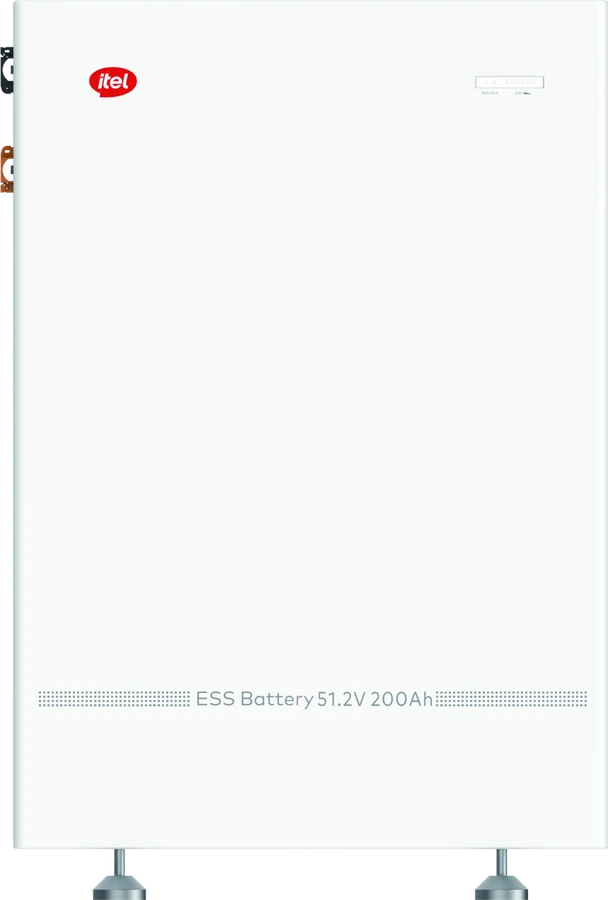
IPL-51200H · 51.2V · 200Ah
This is the H-series image from the manufacturer datasheet. The battery stores 10.24kWh nominally. Its official manual gives 200A maximum persistent charge/discharge current and recommends 100A charging per unit. The published battery-side parallel limit is 32 units; the guide compares one to four.
The supplied itel Nigeria list identifies this 10.24kWh product as IPL-51200H, and its CDcare listing now uses that model. The photograph is the 51.2V 200Ah unit from the H datasheet. A similar-looking cabinet marked 314Ah is the larger 16kWh battery and must not illustrate the 10.24kWh product.
Read the official H manual · See the battery-bank limits and standards review
Can I combine batteries or expand later?
Use only configurations approved for the exact battery model and inverter. Parallel batteries can increase capacity and current capability when they share the load correctly, but the usable result depends on BMS limits, wiring, protection, firmware and the inverter’s own ceiling. Do not assume a mixed bank of X, H, A and other suffixes is approved.
For an expansion plan, agree on the same supported models, connection method, balancing/commissioning process and permissible number of units before buying the first battery. A physically similar cabinet is not evidence of identical cells or electronics.
Cycle life, depth of discharge and installation
Depth of discharge is the fraction of stored energy you use before recharging. Keeping a reserve reduces usable energy for that cycle. Follow the battery’s recommended settings and the warranty conditions instead of assuming every advertised kWh is delivered to your appliances.
A claim such as “6,000 cycles” refers to specified laboratory conditions and an end-of-life capacity threshold. It is not a promise of 6,000 days at full original capacity. Calendar ageing, heat, cycling rate and depth of discharge affect service life. Confirm the warranty offered for the exact model and purchase; design-life language is not the same thing as a warranty.
Mount the battery in the environment permitted by its manual. Do not infer outdoor suitability from an inverter’s IP66 rating: the reviewed IPL-25200X, IPL-51200H and IPL-51314H sheets specify IP20 enclosures. The IPL-51628H distributor table lists IP65; the installed model’s label and mounting instructions govern its location. Use the required ventilation, clearances, DC protection and professional commissioning.
Technical references: itel IPL-25200X manufacturer sheet (Solar Guide mirror) · itel IPL-51200H manufacturer datasheet · itel IPL-51314H manufacturer datasheet
Before you place your order
- Confirm the exact factory model and revision, including X, H or A suffixes.
- Match the battery voltage and operating range to the inverter.
- Check continuous and peak current against the actual load and starting demand.
- Confirm BMS protocol, communication cable, settings and approved parallel configuration.
- Size energy storage for your desired hours of backup and daily charging opportunity.
- Check what the price includes, the warranty and the installation requirements.
Use the product links above to compare the available CDcare listings, then build a system around your actual loads. The right battery is the one that matches your inverter, delivers the required power and stores enough energy for your backup plan.
Common questions about itel batteries
Are 5.12kWh batteries interchangeable?
No. A 25.6V 200Ah battery and a 51.2V 100Ah battery both store 5.12kWh, but they belong to different inverter voltage families. Match the exact voltage and operating range first.
Can I connect two or more itel batteries?
Only use a parallel arrangement approved for that exact model. The planner checks the documented quantity and voltage limits; an installer must also confirm matching units, BMS communication, protection and configuration. More batteries increase storage, while the inverter retains its own power limit.
Which battery should I consider for an 11kW itel inverter?
Our starting recommendation is one 32kWh IPL-51628H battery, with two matching 16kWh IPL-51314H batteries as an alternative. The planner checks current limits separately: stored energy does not guarantee the inverter can deliver full rated power from batteries alone.
Prepared by CDcare. Specifications and sources checked 9 October 2026. Calculations are planning estimates; the exact equipment manuals and a qualified installer determine the final system design.